
Doctors have about as much job security as anyone a lender will ever see. The problem is that medical pay rarely looks like a standard payslip. You might be on a two year foundation programme, rotating between different hospitals every few months, earning a basic salary plus enhancements, picking up locum shifts or drawing profit from a GP partnership. A bank's scoring system can read all of that as risk.
That's where we come in. Whether you're a junior doctor buying your first flat, a registrar moving deanery, a GP partner or a consultant with private practice earnings, we work with mortgage providers who understand how doctors are paid and assess your real income fairly. Some will treat a training contract much like a permanent contract, some will count more of your overtime and banding, and some offer higher income multiples to medical professionals.
Most of our advice is fee free. On over 90% of cases the lender pays us when your mortgage completes, so you get whole of market advice, a lender matched to how you're paid and one person handling the application from start to finish. Mortgages under £100,000 carry a £299 fee, and complex or adverse cases can carry a fee of up to £995. We'll always tell you before you commit.
Fill in the form and we'll call you back, or read on for how lenders look at doctors' pay, what you could borrow and what to have ready. We arrange mortgages for doctors across the UK, not just here in Hampshire.


Most lenders start with a simple question: what do you earn, and how sure can they be that it will carry on? For doctors the answer depends on your grade, your contract and how your pay is made up. Here's how each part is usually treated, and where applications tend to go wrong.

Junior doctors on rotation and fixed term contracts
Foundation doctors (FY1 and FY2) and specialty trainees (CT and ST grades) are usually employed on fixed term contracts that end with each rotation or training programme. Some lenders treat that as temporary work and ask for a long employment history. Others recognise that moving between hospitals is a normal part of training, and at least one major bank assesses medical doctors on fixed term contracts under its standard employed criteria. For a trainee doctor, picking the right lender matters more than anything else.
Newly qualified doctors and future salary
If you've just graduated and have a signed contract for your first foundation post, you may not need to wait for payslips. Some lenders will consider newly qualified professionals, including doctors, whose employment contract starts within a set period, for example three months, using the contracted salary. A few also take your earning potential into account as you progress, but that's lender specific and always subject to affordability.
Overtime, banding and supplements
Junior doctors' pay is often a basic salary plus additional rostered hours, night and weekend supplements, on call availability and, for some, pay protection from older banding arrangements. Many lenders only count part of variable pay and want to see it over several months. Some lenders that work with doctors will accept a larger share of this additional pay. Showing it clearly on your payslips and P60 makes a real difference.
Locum and self employed doctors
Locum doctors paid through an agency or umbrella company, or who invoice as sole traders or through a limited company, are assessed on their track record. Lenders usually want at least 12 months of history, and some want two years of tax calculations. A doctor mixing an NHS contract with regular locum shifts can often have both counted, which is where borrowing capacity can jump.
GP partners, salaried GPs and consultants
Salaried GPs and consultants are usually straightforward employed applications. GP partners are self employed, so lenders use your share of partnership profit from your SA302s or partnership accounts, and timing matters because GP accounts can run well behind the tax year. Consultants with private practice work will normally need tax returns for that part of their earnings.
NHS pension, student debt and other debts
Most lenders work from gross pay, so NHS pension contributions don't normally reduce the salary figure they use, although lower take home pay still feeds into affordability. Student debt repayments are linked to your earnings, so lenders factor in the monthly deduction rather than the balance. Car finance, childcare and credit cards all count too, and a good credit history with a clear address history helps the whole application.

Your bank has one set of lending criteria. If you're a consultant with ten years in post it will probably work. If you're an FY2 about to rotate, a locum with 14 months of invoices or a newly appointed GP partner, it often won't, and the bank won't tell you which lender would have said yes.
We know which lenders understand medical careers. Some lenders have professional mortgage ranges built for doctors, dentists and other professionals, and some are simply better at reading NHS payslips and training contracts. Criteria change often, and keeping track of them is our job.
Fee free on most cases. The lender pays us on completion for over 90% of the mortgages we arrange, so you get access to the whole mortgage market without paying a broker fee. Where a fee does apply, we tell you up front.
Higher income multiples where they're right for you. Most lenders cap borrowing at around 4.5 times income. Some professional mortgages for doctors can go to 5 or 5.5 times, and occasionally more, for applicants who meet minimum income and deposit rules. We'll tell you honestly whether you qualify, and whether stretching that far is sensible.
We present your pay properly. Most declined doctor mortgages come down to paperwork, not earnings. We package your payslips, rota pay, locum invoices or partnership accounts so the underwriter sees the full picture first time. Our team has submitted over 2,500 mortgages, so we know what underwriters ask for.
We work around your rota. Nights, on calls and weekend shifts don't fit office hours. We can talk early or late, by phone or email, and we chase the lender, the agent and the solicitor so you don't have to.
Mortgage and protection together. If illness stops you working, the mortgage still needs paying. We'll talk through income protection, life cover and critical illness cover, and how they sit alongside NHS sick pay and death in service benefits.
Enter your pay the way a lender is likely to see it. Put your basic salary in the first box and your regular overtime, additional hours and supplements in the second, then choose how much of that extra pay a lender might count. Add any locum or private practice profit, and a partner's income if you're buying together. The results show what different income multiples mean in pounds and an illustrative monthly payment.
For illustration only. This is not financial advice or a lending decision. Lenders treat doctors' pay differently, apply their own affordability checks and stress test the interest rate, so the real figure could be higher or lower. Speak to us for a personalised assessment.
Your home may be repossessed if you do not keep up repayments on your mortgage.
Here's a simplified example of why the choice of lender matters for a junior doctor. The figures are for illustration only and aren't a real client.
The doctor: a specialty registrar on a fixed term training contract, with a basic salary of £55,000 and around £12,000 a year of regular additional hours and weekend supplements, shown on 12 months of payslips. She has a £36,000 deposit and a student loan.
A cautious lender: wanted a longer history on a permanent contract and would only use basic salary. At 4.5 times £55,000, that's a maximum of about £247,500.
A doctor friendly lender: accepted the training contract and counted the regular additional pay, giving assessable income of £67,000. At 4.5 times that's about £301,500, and at 5 times on a professional range about £335,000.
The result: a £360,000 home near her next placement, borrowing £324,000 with a 10% deposit, which is about 4.8 times her assessable income. Her maximum borrowing was around £87,500 higher than with the cautious lender.
The catch: more borrowing means bigger monthly payments, and the lender still runs a full affordability check, credit search and valuation. We'd only recommend stretching if the payments sit comfortably within your budget, including when your rota changes.
Try it yourself: put your own numbers into the calculator above, or get in touch and we'll run them against real lender criteria for you.
The right mortgage for an FY1 buying a first flat is not the right mortgage for a consultant moving the family, so here's how we approach each stage.
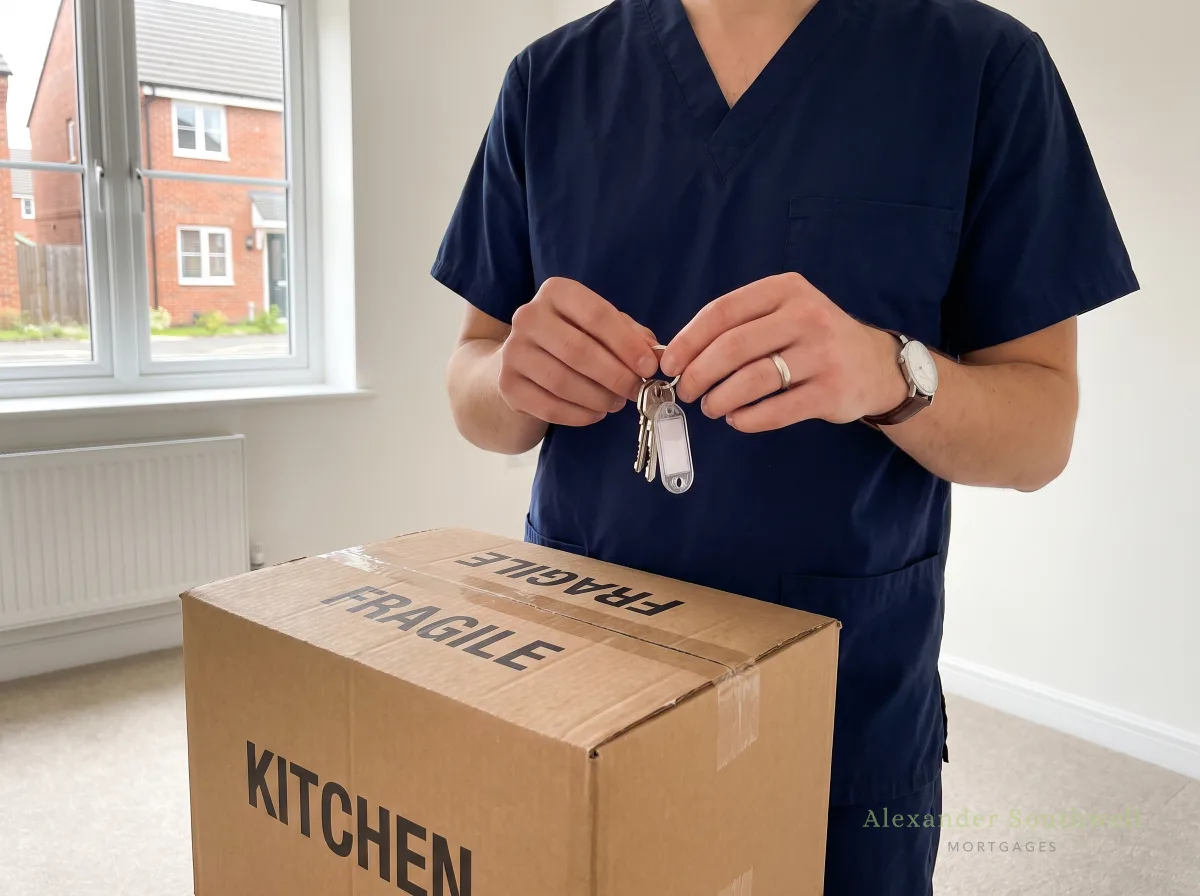
First time buyers and junior doctor mortgages
Starting out with a small deposit? Many lenders offer 5% and 10% deposit mortgages, and a gifted deposit from family is accepted by most. First time buyers also get stamp duty relief in England and Northern Ireland, which you can check with our stamp duty calculator. If you've got a job lined up but haven't started, we'll look at lenders that can use your contract. See also 5% deposit mortgages.
Moving deanery or changing hospitals
If your next placement is in a different region, you might want to buy near the new hospital, keep your current home or rent for a while first. We plan around your rotation dates, check how a lender views a contract that's about to change and look at porting your current deal when you move. Our moving home mortgages guide covers the detail.
Consultants and private practice
Consultants often combine an NHS salary with private practice earnings, sometimes through a limited company. We look for lenders that can use both parts properly, including where the private work is fairly new, and that are comfortable with larger loans for family homes.
GP partners buying or remortgaging
New partners often have a strong salaried record but only a short history as a self employed partner. Lenders differ on how much partnership history they need, and on whether a recent move from salaried GP to partner is treated as continuous work in the same field. We'll find the one that fits your timing.
Remortgaging to a better deal
When your fixed rate ends you'll usually move onto the lender's standard variable rate. We'll get in touch well before, compare a product transfer with your current lender against a full remortgage, and handle the switch so you're on the best deal we can find for you.
Credit history and help from family
Years of student living and short term contracts can leave gaps on your credit file or a patchy address history. Checking early helps, and our Check My File guide explains how. If family want to help, guarantor mortgages or a joint borrower sole proprietor mortgage may be worth a look.
Getting documents together early is the simplest way to speed up a mortgage application. Lenders want full PDF downloads or originals, not screenshots, and this is what we'll usually ask for depending on how you work.
Everyone: photo ID, proof of address such as utility bills, three months of bank statements, proof of your deposit and details of any credit commitments, including your student loan.
Employed and training doctors: your last three payslips, latest P60 and your employment contract, or for rotations the contract with your lead employer or trust.
Newly qualified doctors: your signed contract or offer letter showing your salary and start date, plus proof of GMC registration if the lender asks for it.
Locum doctors: 12 months of invoices or umbrella payslips with matching bank statements, or SA302s and tax year overviews if you're self employed.
GP partners: two years of SA302s and tax year overviews, or partnership accounts, and your partnership agreement. Some lenders will work from one year.
Consultants with private work: NHS payslips and P60, plus tax returns or company accounts showing your private practice income.
A proper conversation
We talk through your grade, contract, rota pay and plans, then tell you what you could borrow and roughly what it would cost each month.
Agreement in principle
We pick the lender whose criteria suit how you're paid and get your agreement in principle, often the same day, so estate agents take you seriously.
Paperwork, done once
We tell you exactly what to send, check it and package it so the underwriter sees a clear picture of your medical income.
Application and underwriting
We submit the application, answer the underwriter's questions and keep you updated. The lender arranges the valuation.
Mortgage offer
Typically two to four weeks from applying, depending on the lender. We check the mortgage offer with you and send it to your solicitor.
Completion and beyond
Your solicitor exchanges and completes. We'll be in touch before your rate ends so you can review your mortgage deal in good time.
Can a GP partner get a mortgage?
Yes. As a partner you're self employed, so lenders use your share of partnership profit, usually from SA302s and tax year overviews. Newly appointed partners may find some lenders ask for a longer track record than others, which is where choosing the right one helps.
Does my NHS pension affect what I can borrow?
Your pension contributions don't usually reduce the salary figure a lender uses, as most work from gross pay. For doctors borrowing into later life, some lenders will also look at expected NHS pension income to check the mortgage stays affordable after you retire.
When should I get an agreement in principle?
Before you start viewing properties seriously. It shows estate agents you're a credible buyer and confirms roughly how much a lender would consider. Many lenders use a soft credit search for this, and we'll tell you which type before we apply. Our mortgage in principle guide explains more.
Why use a mortgage broker instead of my bank?
Your bank can only offer its own products and criteria. A broker who arranges mortgages for doctors knows which lenders suit rotations, locum work and partnership income, and can compare deals across the market, usually at no cost to you.
Doctors often fit more than one box, so these guides cover the situations that most often overlap with doctor mortgages. For contracts, pay and training terms, the British Medical Association is a good place to start.
Book a free, no obligation chat with a specialist mortgage broker for doctors. We'll work out what you could borrow on your real income, explain your options and get your agreement in principle sorted, fee free on most cases.