
Mortgages for teachers should be simple. You've got qualified teacher status, a pay scale that rises every September, a solid pension and about as stable employment as any profession going. Yet I regularly speak to newly qualified teachers told by their bank to come back after three payslips, and supply teachers turned down because their income "doesn't fit".
The problem isn't teachers. It's that every lender has its own rulebook on fixed term contracts, agency work, term time only pay and September start dates. One wants twelve months of payslips. Another will lend on a signed contract before you've taught a lesson. My job as your mortgage adviser is to know which is which before we apply, so you only apply once.
I'm Jamie Alexander, director of Alexander Southwell Mortgage Services in Romsey, Hampshire. I've spent 15 years in mortgages, and as a team we've submitted over 2,500 applications. We're whole of market and fee free on over 90% of cases. Mortgages under £100,000 carry a £299 fee and complex or adverse cases can carry a fee of up to £995, and you'll always know before you commit.


A lender wants to know what you earn and how sure it can be that you'll keep earning it. For teachers the second part is easy. The first gets muddled by scale points, allowances and deductions. Here's how each piece is usually treated.
Main pay range and upper pay range
On a permanent contract, basic salary is the easy bit. Outside London the main pay range runs from around £34,000 at M1 to just under £47,000 at M6, and the upper pay range tops out near £52,800. Some lenders will use your next pay point if the school confirms it in writing.
ECTs starting in September before the first payslip
This is the bit that trips people up. Newly qualified teachers want to buy over the summer, before they've been paid. Plenty of lenders won't touch it. Others lend on a signed contract with a start date within three months, and Teachers Building Society treats a 12 month initial ECT contract as permanent. Your NQT year isn't a probationary period as lenders mean it, but it needs explaining.
TLR payments, SEN allowances and other extras
A TLR1 or TLR2 is contractual and paid monthly, so most lenders count it in full, along with SEN allowances in your contract. Lenders get twitchy about anything temporary, so a fixed term TLR may be discounted. Exam marking and after school clubs are variable: some lenders average it over two years, some take half, a few ignore it.
Supply teachers paid through agencies and umbrella companies
Supply teaching is the hardest teacher income to place, not because it's low but because it's uneven and often paid through an umbrella company. Lenders that accept it want a 12 month history, sometimes 24, and average your earnings, quiet August included. If you've recently moved from permanent teaching to supply, certain lenders will still consider your history.
Part time, job share and term time only contracts
Part time teachers and job shares are assessed on the pro rata annual salary in the contract. Term time only contracts, common for teaching assistants, are annualised, so your payslip already shows a twelve month average. The trap is a lender's system reading "39 weeks" and assuming a gap. A short note from us normally sorts it.
Teachers' Pension, student loan and other deductions
Lenders work from gross salary, so your Teachers' Pension contribution (7.4% to 12%) doesn't usually reduce your borrowing. Your student loan does count: Plan 2 repayments of 9% above the £29,385 threshold come off take home pay, roughly £68 a month on £38,400. Rarely a deal breaker, but it's why two teachers on the same salary can be offered different amounts.

Your bank has one set of criteria. If its rules say three payslips, that's the end of the conversation. We have access to the whole market, including lenders set up for education professionals, and we know how each one treats ECTs, supply work and TLRs.
We know which lenders like teachers. Some offer higher income multiples or 5% deposit deals to key workers and qualified professionals. Others simply understand the September cycle and aren't spooked by a contract that hasn't started. We go to those first.
We present your income properly. A supply teacher with 14 months of umbrella payslips and a tutoring sideline is not "irregular income". Presented to the right lender with the right paperwork it's a good application, and we do the presenting.
Better rates, not just a yes. Two lenders that both say yes can be hundreds of pounds a month apart, and the lowest rate isn't always the cheapest once fees and cashback are counted. We compare the total amount you'd pay over the deal.
Mortgage and protection together. Teachers' sick pay tapers after the first few years, and the pension's death in service benefit may not clear a mortgage on its own. We'll talk through life cover and income protection alongside the mortgage, so you decide once.
Put your pay in the way a lender is likely to see it: basic salary from your scale point, then TLRs and extras separately, because the lenders offering the best teacher mortgages don't all count them the same way.
This calculator is for illustration only and is not financial advice. It does not take account of your outgoings, credit history or a lender's full affordability assessment, and the interest rate is an example, not a quote. Your actual borrowing could be lower or higher.
Your home may be repossessed if you do not keep up repayments on your mortgage.
A simplified version of a case we see every summer. Numbers rounded, but the difference between lenders is real.
The teacher: Priya has finished her PGCE and has a signed contract to start at a secondary school in Eastleigh on 1 September at M1, around £34,000. It's late June. She has a £16,000 deposit, part gifted, a Plan 2 student loan, and she'd rather buy a £240,000 flat than rent another year.
A cautious lender: Her bank wants three months of payslips from the new job, so December at the earliest. It also caps her at 4.5 times income, so £153,000. Not enough.
A teacher friendly lender: A lender that accepts a signed contract with a start date within three months treats her as employed from June, counts her full M1 salary and, as a qualified professional, goes to 5 times income, subject to affordability. That's £170,000.
The result: Priya needs £224,000, so even the friendlier lender is short. We look at a smaller flat, a joint borrower sole proprietor mortgage with her dad, or shared ownership. She chooses a 50% share, completes in mid August and moves in before her first day.
The catch: Lending before the first payslip usually means the lender wants the contract, an employer's reference confirming start date and salary, and sometimes proof of QTS. Get those together in June, not August, when the school office is shut.
Try it yourself: Change the salary and deposit in the calculator above and watch the multiples move. Then get in touch and we'll tell you which lenders would actually offer those figures for your situation.
The right mortgage for an ECT buying a one bed flat isn't the right one for a deputy head moving county for a new post.

First time buyers and 5% deposit mortgages
Most teachers we help are first time buyers, and a minimum deposit of 5% is realistic. The government's mortgage guarantee scheme became permanent in July 2025, so 95% deals are widely available. See our guides to first time buyer mortgages and 5% deposit mortgages, and check our stamp duty calculator before you fix a budget.
Shared ownership and First Homes
Shared ownership lets you buy a share of a home, often 25% to 75%, and pay rent on the rest. First Homes sells new builds to first time buyers at a discount of at least 30%, and councils can give key workers priority for the first three months. Not every lender accepts these schemes.
Moving areas for a new teaching position
Teachers move for jobs more than most, and a first teaching position or a promotion in a new county often means buying before you've started. Lenders that accept a signed contract solve half of it. The other half is timing: we can usually port your existing rate, or line up a moving home mortgage so completion lands in the holidays rather than week three of term.
Help from family: guarantor and JBSP mortgages
Parents often want to help without handing over a lump sum. A joint borrower sole proprietor mortgage adds a parent's income to the application without putting them on the deeds. A guarantor mortgage uses a parent's savings or property as security instead. Either can lift an ECT from "not quite" to "yes".
Teaching assistants, cover supervisors and support staff
Teaching assistants, HLTAs and cover supervisors are usually on term time only contracts, and we help them every week alongside NHS staff, nurses, doctors and police. The annualised salary is what counts, and the same 5% deposit and shared ownership routes apply. A longer term or a joint application is often the practical route on to the property ladder.
Getting documents together early is the biggest thing you can do to speed up the mortgage process. We'll tell you exactly which apply to you.
Everyone: Photo ID, proof of address, three months' bank statements, evidence of your deposit and where it came from, and a credit report. Our Check My File guide explains how to see what lenders see.
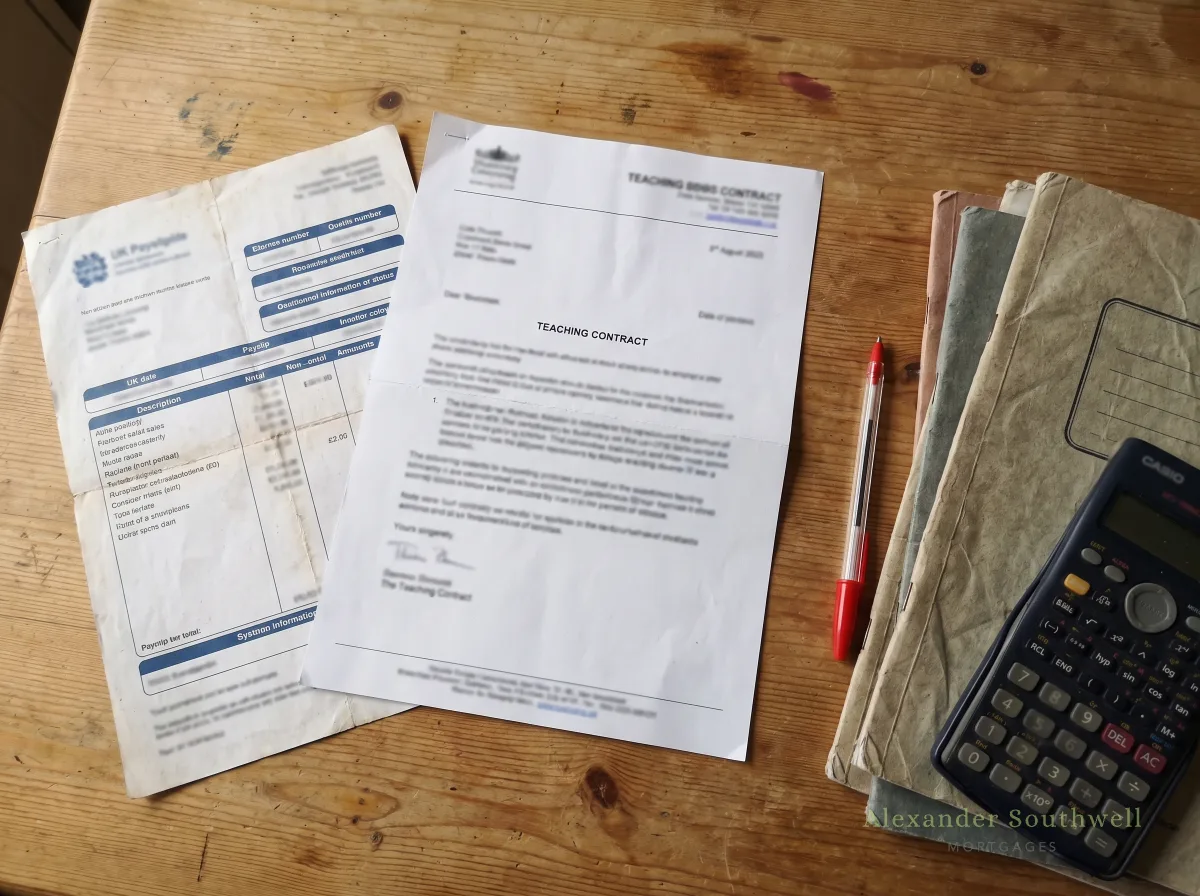
Employed teachers: Your last three payslips (some lenders accept one), latest P60, and your contract if there's a TLR, an allowance or a pay point about to change.
Newly qualified teachers: Your signed contract or offer letter showing salary, start date and hours, plus an employer's reference if asked. Some lenders want proof of qualified teacher status too, so keep your QTS certificate handy.
Supply teachers: Twelve months of payslips or umbrella company statements, your P60 or tax year summary, and a note of which agencies you work through. If you're self employed rather than through an umbrella, your last one or two years' SA302s and tax year overviews.
A proper conversation
We talk through your contract, pay, deposit and plans, usually 20 minutes by phone or video outside school hours.
Agreement in principle
We choose the lender whose criteria suit how you're paid, then get a mortgage in principle so you can make offers with confidence, often within 24 hours.
Paperwork, done once
We tell you exactly what to send and handle the lender's questions about your contract or payslips.
Application and underwriting
We submit, chase the valuation and answer any underwriter query about term time pay or a September start.
Mortgage offer
Typically two to four weeks from application. We check the offer line by line, then hand over to your solicitor.
Completion and beyond
Ideally completion lands in the holidays. We diarise the end of your fixed rate so you don't drift on to the standard variable rate.
Are academy teachers treated differently from maintained school teachers?
No. Lenders assess the contract, salary and start date, not who runs the school. Academy trusts, local authority schools, free schools and independent schools are all employed income, treated the same way. The one thing to flag is a school paying off the national scales, as a lender may query it.
I'm a teaching assistant on a term time only contract. Can I get a mortgage?
Yes. Your contract shows an annualised salary, which is the figure lenders use, and the 5% deposit, shared ownership and First Homes routes are all open to you. A joint application with a partner often gets you the borrowing you need. We help support staff as often as teachers.
We help key workers across the whole education sector. For official information on your pension, visit Teachers' Pensions. Browse the guides below for the mortgage side.
Speak to a fee free mortgage adviser who understands teachers' pay. Evening and weekend appointments available.