
There is no government police mortgage scheme. I say that first because a lot of officers ring me having read somewhere that there is. What actually exists is a group of mortgage lenders who like police pay for what it is: long term employment, a pension, a rank structure with visible pay rises, and a job that does not vanish in a recession. The trick is putting your income in front of the right one, in the right order, with the right paperwork.
That is the whole of what we do. Alexander Southwell Mortgage Services is a whole of market mortgage broker based in Romsey, so a good number of the officers we help are with Hampshire Constabulary, though we arrange police mortgages across the UK, from Metropolitan Police officers in London to the smaller county forces. We deal with UK high street banks, building societies and the more flexible lenders offering better treatment of overtime, and we know their lender criteria well enough to tell you in one phone call roughly where you stand.
Fees: we are fee free on over 90% of cases because the lender pays us on completion. Mortgages under £100,000 carry a £299 fee, and complex cases or adverse credit can carry a fee of up to £995. You'll know before we do any work, and you'll never be charged for a first conversation. We're authorised and regulated by the Financial Conduct Authority, FCA No. 1011890.
Fill in the form and we'll call you back at a time that suits your shift pattern. Nights, rest days, a quick chat in the car before a late turn: it's all fine by us.



Some lenders will accept a signed offer of appointment and a start date, so you can get a mortgage in principle before you have received a single police payslip. Others want you through your first few months. We know which is which, and we'll tell you honestly whether it's worth applying now or waiting for that first payslip.
Overtime, unsocial hours payments and shift allowances can be a big slice of police pay, and the way lenders treat them varies wildly. Some ignore them. Some count half. A few count all of it with a good history. Getting that decision right is often the difference between the house you want and the one you'd settle for.

Officers can retire in their fifties with a police pension, and most lenders will happily lend on that pension income. Many will also run a mortgage past a planned retirement date as long as the numbers still work on the pension, which matters if you want a 25 year term at 45. We'll show you how each lender treats it.

When your fixed rate ends we search the whole mortgage market for you, and if your current lender's product transfer is genuinely the best deal we'll tell you that too. Most lenders offer a free valuation and free legal work on a standard remortgage, so switching usually costs nothing but a phone call.

Alongside standard police mortgages there are government schemes worth knowing about: 5% deposit mortgages backed by the government's mortgage guarantee, shared ownership, and First Homes, where councils can give key workers first refusal on discounted new build properties. We'll tell you which ones actually help in your area.

Every lender starts from the same question: what do you earn, and how sure can they be it will keep coming? For the police the honest answer is very sure, but the payslip does not always say so clearly. Here's how the main parts of police pay land with mortgage lenders, and where the sticking points are.
Basic pay from constable to inspector
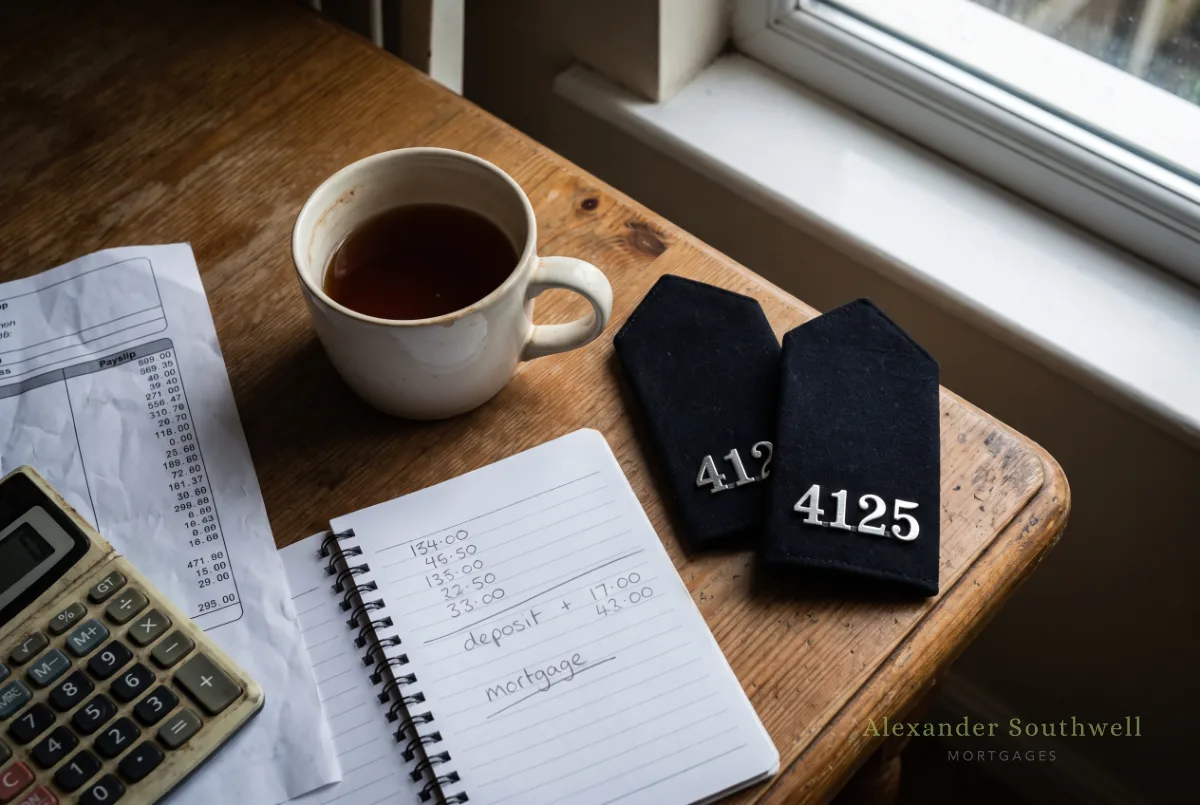
After the September 2026 pay award a constable outside London starts on roughly £32,000 and reaches about £52,000 at the top of the scale, a sergeant tops out near £58,000 and an inspector around £71,000. Basic pay is the one figure every lender takes at face value, so even without a penny of overtime a constable a few years in is a solid applicant. A pay point rise confirmed in writing can sometimes be used before it reaches your payslip.
Probationers and student officers
Probation lasts two years, and this is the bit that trips people up on a police officer mortgage. Some lenders won't lend until you're confirmed in post. Others treat police probation like any other and lend from day one, or even from a signed offer of appointment with a start date. If you're joining a UK police force through the degree apprenticeship route, expect a few lenders to ask about the training contract too. A PCSO mortgage works the same way once your own probation is done. We check before anything is submitted.
Overtime, unsocial hours and shift allowances
Lenders get twitchy about anything that isn't guaranteed. Most want three to six months of payslips showing the extra pay, and some want a P60 too. From there the split is roughly this: cautious lenders count none of it, many count half, and a few count all of it when it's consistent. On £8,000 of regular overtime that can mean anything from nothing to £36,000 more borrowing, so this choice matters more than the headline rate.
London weighting and South East allowance
Met and City of London officers get London weighting plus a London allowance that can be worth more than £6,500 a year. Several forces around the capital, Hampshire included, pay a South East allowance too. These are regular, contractual payments, so most lenders treat them like basic pay rather than bonus. Make sure your application shows them separately, because a lender that lumps them in with overtime may only count half.
Housing and rent allowance
If you joined before September 1994 you may still receive a protected housing or rent allowance. It's rare now, but it's contractual, so it usually counts in full. Newer officers don't get it, and there isn't a modern replacement, however often the internet says there is.
Pension contributions and other deductions
Police pension contributions are high, from 12.88% of pay for lower earners to 14.22% at the top under the 2015 scheme rates from April 2026, and they come off before tax. Most lenders work from gross salary, so the contributions rarely cut what you can borrow, but a few build them into their affordability model and lend a little less. Student loans, Federation subs and childcare get picked up the same way. We model your real take home before we pick a lender.
Your own bank has one set of rules for police pay and no reason to bend them. We deal with dozens of different lenders, including a handful whose criteria happen to suit shift work, probation and allowances very well. Good police mortgages come down to that choice: the difference between an acceptable rate and the most suitable mortgage deal for you.
We know which lenders count what. Half a rest day on the phone to lender helpdesks is nobody's idea of fun. We already know who takes overtime in full, who accepts a start date and who wants two years of P60s. That list can change quickly, so we keep it current.
Fee free on most cases. The lender pays us on completion, so on over 90% of police mortgages there is nothing to pay. Where a fee applies, on small loans, adverse credit or complex cases, we tell you up front and in writing.
Higher multiples where they're deserved. Most lenders cap borrowing around 4.5 times income. Some go to 5 or 5.5 times for applicants with stable, well evidenced pay, and police pay qualifies with several of them. We'll show you both numbers and what each would cost a month.
Adverse credit isn't the end of it. A missed payment during a divorce or an old phone contract default doesn't stop you being a good officer, and it needn't stop you buying. We check your credit report first, quietly, and go to the lender who'll look at the whole picture.
We work around your shifts. Earlies, lates, nights: we'll call when you can talk. Most of our clients never come to the office. Everything can be done by phone, email and secure document upload.
Protection that fits the job. Police injury and ill health benefits are decent but not the whole story. We'll look at life cover and income protection alongside the mortgage, and we'll tell you plainly if what you have through the force is already enough.
Put your pay in the way a lender would see it: basic salary first, then overtime, then how much of that overtime a lender might count. Contractual allowances such as London weighting or South East allowance go in their own box because most lenders count them in full. The tiles show the income multiples we see most often on police mortgages and a rough monthly payment. It is a guide, not an offer.
This calculator is for illustration only and is not financial advice. Lenders use their own affordability models, and the multiple you are offered will depend on your deposit, credit history, other commitments and each lender's rules on overtime and allowances.
Your home may be repossessed if you do not keep up repayments on your mortgage.
A simplified example based on the kind of case we see most weeks. Figures are rounded, the lenders are anonymous and your own numbers will differ. The calculator above opens with these figures so you can follow along.
The buyers: a constable four years in on £41,000 basic with £7,000 a year of regular overtime, and a PCSO partner on £30,000. First time buyers with a £24,000 deposit, a clean credit file and one car loan.
A cautious lender: ignored the overtime completely, took joint income as £71,000, applied 4.5 times and offered about £319,500. Not bad, but short of the £336,000 they needed for a £360,000 three bed near Eastleigh.
A police friendly lender: counted the overtime in full because it showed on six consecutive payslips and the P60. Joint income became £78,000, and the same 4.5 times multiple gave about £351,000, before the car loan trimmed it a little.
The result: a £336,000 mortgage over 35 years at about 93% loan to value. Same couple, same payslips, roughly £31,500 of difference in borrowing between the two lenders, and only one of them bought the house.
The catch: borrowing more means paying more every month, and a 35 year term costs more in interest overall than 25 years. If the overtime dries up, the mortgage payment doesn't. We checked the monthly figure against their basic pay alone before anyone signed anything.
Try it yourself: change the figures in the calculator above, then get in touch and we'll tell you which lenders would look at your case as it stands today.
The right mortgage for a probationer on £32,000 is not the right one for a sergeant remortgaging a family home, and neither suits a retired officer buying near the grandchildren. Here's how we approach police mortgages at each stage.
First time buyers with a small deposit
A 5% deposit is a realistic starting point on police pay, and most big lenders offer 95% mortgages. Expect slightly higher rates than at 10% or 15% down, and expect pickier rules on new build flats. Our first time buyer mortgages guide and 5% deposit mortgages page cover the detail, and the stamp duty calculator shows what, if anything, you'll pay on top.
Shared ownership and First Homes
Shared ownership lets you buy a share, often 25% to 75%, and pay rent on the rest, which suits officers in expensive patches around London and along the south coast. First Homes sells new build properties at 30% to 50% off, and councils can give key workers, the police included, priority for the first three months a home is on sale. Both need a lender that does the scheme, and not all do.
Probationers using family help
If you're in probation and the numbers are close, a joint borrower sole proprietor mortgage lets a parent's income boost your borrowing without them owning any of the house. A guarantor mortgage does a similar job using their savings or home as security. Both let you buy now and take them off later once your pay has caught up.
Transferring forces and moving home
Transferring from one force to another normally keeps your continuous service, and most lenders treat it like staying with the same employer, though the odd one wants a confirmation letter from the new force. If you're selling at the same time, our moving home mortgages page explains porting, early repayment charges and how to time it all.
Remortgaging and product transfers
A remortgage is also the moment to shorten the term, borrow a little extra for the loft, or add a partner to the mortgage. We compare the whole market against your current lender's product transfer and give you the answer straight. Our remortgages page has more on how it works.
Retired officers and police pensions
A police pension is guaranteed income and lenders like it. Retired police officers can borrow into later life with a number of lenders, and a second career after leaving the force counts too. If you're planning to retire during the mortgage term, we'll pick a lender that assesses your pension now rather than one that panics at 55.
Getting the documents together early is the single biggest thing you can do to speed up a police mortgage. This is the usual list.
Three months of payslips: six if we're counting overtime or shift allowances, ideally a run of months without a gap so the lender can see the pattern.
Your latest P60: and the one before if a lender wants a two year average of your extra pay. Your force HR or payroll portal usually has both.
Offer of appointment or confirmation letter: for probationers, student officers and anyone who has just transferred forces. It needs your start date, role and salary on it.
Three months of bank statements: the account your pay goes into plus any you spend from. Lenders do read them, so clear up unarranged overdrafts and gambling transactions before you apply.
Proof of deposit and ID: savings statements, a gifted deposit letter if family are helping, and photo ID with proof of address. And no, a warrant card won't do as ID.
Your credit report: we ask every client to download theirs before we apply. Our Check My File guide explains how, and it means we go to the right lender first time rather than leaving search footprints.
A proper conversation
Fifteen minutes on the phone about your role, service, pay, deposit and what you're hoping to buy. If anything looks like a problem, you'll hear it from us straight away.
Mortgage in principle
We pick the lender whose rules suit your pay and run a mortgage in principle, often the same day, so you know your budget before you fall for a house.
Paperwork, done once
You get a short list of exactly what's needed and upload it securely. We check it all before a lender sees it, which is where most delays get avoided.
Application and underwriting
We submit the mortgage application, chase the valuation and handle the underwriter's questions. If they query an overtime figure or a start date, we answer with evidence, not hope.
Mortgage offer
Typically two to four weeks from application. We check the mortgage offer line by line, then pass it to your solicitor with our notes.
Completion and beyond
Your solicitor exchanges and completes and you collect the keys. A few months before your fixed rate ends we'll be in touch about next steps, so you don't drift onto a standard variable rate.
How much can a police officer borrow?
As a rough rule, 4.5 times your assessable income with most lenders, and up to 5 or 5.5 times with a few for stable pay. Assessable income means basic pay plus whatever share of your overtime and allowances the lender accepts, so two officers of the same rank can get very different answers. The calculator above gives you a range.
Does the police pension affect mortgage affordability?
Pension contributions come off your pay before tax, and most lenders work from gross salary, so they rarely reduce what you can borrow. A minority of lenders build the deduction into their affordability model and lend slightly less. If you're close to the limit we'll steer you to one that doesn't.
When should I get a mortgage in principle?
Before you book viewings. A mortgage in principle shows estate agents you're serious and gives you a realistic budget. Where we can, we use a lender whose first check is a soft search, so it doesn't dent your credit file.
Does it matter how far I live from my station?
Lenders don't mind where you work, but you might. A long drive home after a night shift is miserable, and a cheaper house forty minutes away can cost you more in fuel and sleep than it saves. We're happy to talk through areas as well as numbers, and we know the Southampton, Winchester and Romsey markets well.
Police households often fit more than one of our guides, and plenty of the officers we help have a partner who is also a key worker. For questions about pay and conditions, your local Police Federation branch is the place to start.
Speak to one of our mortgage advisers today about police mortgages. We'll work out your mortgage affordability, explain your options in plain English and help you move forward with confidence.