

For most people the honest answer is around 4 to 4.5 times their income, minus an allowance for what they already pay out each month. Here is exactly how our calculator gets there, in plain English.
Step 1: the income used We add up basic salary for each applicant, plus the share of bonus, overtime or commission you choose to count, plus any other regular income. Two applicants on £40,000 and £30,000 with no bonus have an income used of £70,000.
Step 2: the multiples We multiply that income by 4, 4.5, 5, 5.5 and 6. On £70,000 that gives £280,000 at 4 times up to £420,000 at 6 times. Most lenders sit at 4 to 4.5. The higher figures are for higher earners and certain professions, and are never guaranteed.
Step 3: commitments and deposit We take off your monthly commitments times 129.56, roughly what that money would repay on a mortgage at 8% over 25 years. Then we add your deposit to get the property price, and divide the loan by the price for your loan to value (LTV).
How lenders decide
Every lender asks two questions. How much does your income support on paper? And once your bills, debts and family costs are out, can you afford the payments if rates go up? The lower answer is what they lend.
That is why the same couple can be offered £260,000 by one bank and £310,000 by another on the same day. Nobody is wrong, they just weigh things differently. Knowing which lender suits which person is a big part of my job.

| Income multiple | Who it usually applies to | On £50,000 a year |
|---|---|---|
| 4 to 4.5 times | Most lenders. The realistic figure to plan around. | £200,000 to £225,000 |
| 5 times | Some lenders, often with a clean credit file and a bigger deposit. | £250,000 |
| 5.5 times | Fewer lenders, usually for bigger earners or first time buyer schemes with strict criteria. | £275,000 |
| 6 times | A handful of lenders, mainly for higher earners and certain professions such as doctors, dentists, solicitors and accountants. | £300,000 |
These are before commitments come off, and none are guaranteed. Lenders can only write a limited share of mortgages at 4.5 times income or more across the market, which is one reason the bigger multiples come with tighter rules.
Your annual income times a number, usually 4 to 4.5. For a joint mortgage they add each applicant's income together. Basic salary counts in full. Bonuses, overtime and commission often count at 50% to 100% depending on how regular they are.
Since the 2014 mortgage rules, every lender has to check mortgage affordability properly. They take your net pay, knock off credit commitments, childcare and an estimate of household expenses, and see what is left. More dependants usually means a smaller figure.
Lenders test your mortgage payments at a rate above the one you would actually pay. Since August 2022 there is no single Bank of England stress rate, so each lender sets its own, but FCA rules still make them allow for interest rates going up. A five year fix is sometimes tested more gently than a two year deal.
A full application includes a hard credit check. Missed payments, maxed out cards or payday loans can cut the figure or rule lenders out. Look at your file before you apply. Our Checkmyfile guide shows how to see the main agencies in one report.
What brings the number down
This is the bit that trips people up. Two people on the same pay can get very different answers because of what goes out each month, not what comes in.
Every £100 a month of loan or PCP payments can take roughly £13,000 off. A £300 a month car deal can cost you about £39,000 of borrowing, which is why I always ask when it ends.
Lenders often treat a card balance as a monthly payment of 3% to 5% of what you owe, even if you pay more. £5,000 on cards can count as £150 to £250 a month.
Nursery fees are one of the biggest outgoings lenders see. £800 a month can reduce borrowing by over £100,000 on some models. Each child also adds to the living costs they assume.
Probation periods, bonuses that change every year, a few months of overtime or newly self employed income can all be scaled back. That is why the calculator lets you choose how much bonus to count.
Ways to borrow more
A word of caution first. Borrowing the maximum is not the same as being comfortable, and I would rather you could still pay when the boiler goes. These are the options that genuinely increase the number.
Adding a partner is the biggest single change for most people. Incomes of £35,000 and £30,000 could support around £260,000 to £292,500 before commitments, against £140,000 to £157,500 alone.
A parent can add their income without going on the deeds. See our joint borrower sole proprietor mortgage guide, or a guarantor mortgage where family back the loan instead. Both carry real risk for the family member, so they need their own advice.
A longer term lowers the monthly payments the lender tests. £200,000 at an illustrative 4.5% is about £1,112 a month over 25 years and £947 over 35. You pay more interest overall, and most lenders want it repaid by retirement.
Paying off a loan with a few months left can add more borrowing than it costs. A bigger deposit lowers your loan to value, which can mean better mortgage rates, and lenders offering 5 times income or more often insist on it. We run both versions before you decide.
Your circumstances
The calculator treats everyone the same. Lenders do not, and for these groups the real answer can be quite different in either direction.

Lenders use your tax calculations or accounts, usually two years. Sole traders are judged on net profit, directors on salary plus dividends, and some lenders use retained profit too. Enter your average income as salary, then read our self employed mortgages guide or contractor mortgages if you work on day rates.
Shift allowances, unsocial hours and overtime are counted more generously by some lenders, and some offer enhanced multiples for newly qualified professionals. See our key worker mortgages hub, including NHS mortgages and mortgages for teachers.
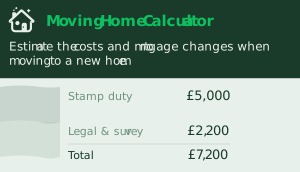
If you are buying your first home you can usually borrow at the same multiples as anyone, and a few lenders run schemes with bigger multiples for those who qualify. Most need a 5% deposit. Our first time buyer mortgages guide covers the process and 5% deposit mortgages covers buying with a small deposit. If you already own and want to remortgage or move, the same affordability rules apply to a new mortgage. Budget for stamp duty and fees too with our stamp duty calculator.
Worked examples
These use the same maths as the calculator above, so you can check them. They are made up clients, not offers.
Sophie earns £38,000, pays £250 a month on car finance and owes £2,000 on a card, counted at 3% so £60 a month. Her £310 a month takes about £40,165 off (£310 × 129.56).
At 4.5 times: £38,000 × 4.5 = £171,000, minus £40,165 = about £130,800. With a £20,000 deposit that is a price of around £150,800 at 86.7% LTV. Without the car finance and card it would be £171,000.
Tom earns £45,000 plus £6,000 overtime and Priya earns £32,000. Counting half the overtime gives £80,000. Nursery costs £650 a month, which takes about £84,200 off.
At 4.5 times: £80,000 × 4.5 = £360,000, minus £84,200 = about £275,800. With a £40,000 deposit that is a price of about £315,800 at 87.3% LTV. Lender choice really matters for them.
Alex earns £95,000, has no commitments and an £80,000 deposit. The range: £380,000 at 4 times, £427,500 at 4.5 times, up to £570,000 at 6 times. Most lenders would sit at the lower end. The payments at the top would be a big commitment, so we would test that carefully first.
129.56 is what £1 a month would repay on a mortgage at 8% over 25 years. It shows that a monthly commitment reduces borrowing by far more than its yearly cost. Each lender uses its own version.
What your result means
Treat the 4 to 4.5 times annual income figure as your planning number and anything above it as a maybe. The calculator is there to give you an idea of how much you could borrow. Before you start viewing homes to buy, here are the steps to turn it into something an estate agent takes seriously.

An agreement in principle (AIP) is a lender saying they would lend a set amount, subject to a full application. Many use a soft search, and agents often want one before accepting an offer. Read our mortgage in principle guide.
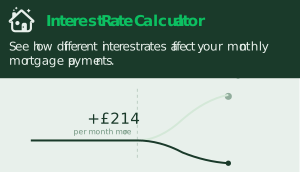
What you could borrow and what you are happy to pay are different things. Use our mortgage repayment calculator for the monthly cost, and our interest rate change calculator to see the impact if mortgage interest rates move.
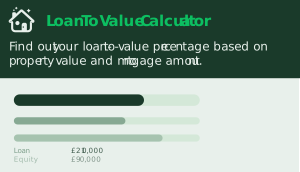
Your deposit and the property value set your LTV, and LTV sets your rate. Our loan to value calculator shows where the bands fall. Moving home? Try the moving home calculator.
We look at your figures against real lender criteria before anything goes in, so you know how much money you can count on and we can help you find the right lender. We are fee free on over 90% of cases. There is a £299 fee on mortgages under £100,000, and complex or adverse cases can carry a fee of up to £995, agreed upfront.
Want a real figure rather than an estimate?
Call 03300 432 428 or book a free appointment. It takes about 20 minutes and there is no obligation.

Frequently asked questions
The questions I get asked most about how much you could borrow.
They take your income, deduct credit commitments and living costs, then check you could still keep up the monthly repayments if rates rose. They lend the lower of that and their income multiple cap.
Most lenders need at least 5% of the price. A 10% or 15% deposit usually means more lenders and better rates, especially if you want a bigger income multiple.
The multiples are the same, but the income comes from your accounts or tax calculations. Lenders differ on whether they use your latest year or a two year average.
No. It is an illustration based on simple details. Lenders use their own affordability models and credit checks, so your actual figure may be more or less.
Your rent stops when you buy, so lenders do not count it as a commitment, although your other outgoings still affect the figure. A good record of paying rent on time can still help some first time buyer applications.
Important information: your home is security for the loan and may be repossessed if you do not keep up repayments on your mortgage. This calculator and guide are for illustration only and are not financial advice. Alexander Southwell Mortgage Services is authorised and regulated by the Financial Conduct Authority, firm reference 1011890.